






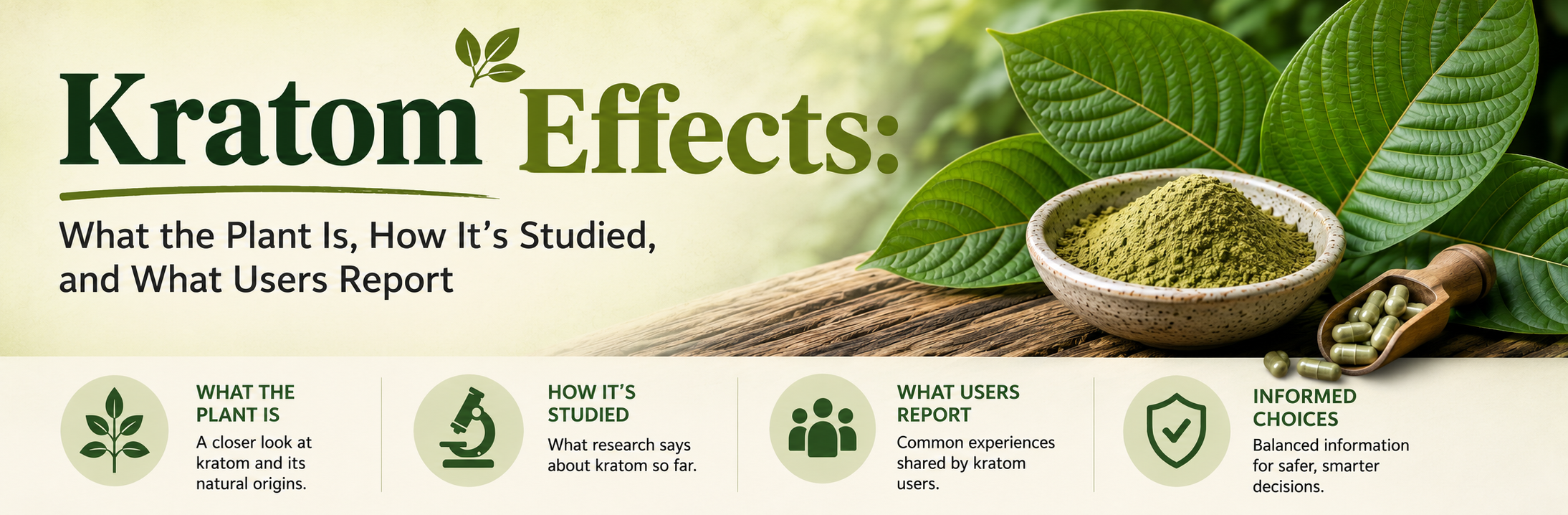
Kratom Effects: What the Plant Is, How It’s Studied, and What Users Report
Kratom (Mitragyna speciosa) is a tropical tree in the coffee family, native to Southeast Asia. Its leaves contain alkaloids — mainly mitragynine and 7-hydroxymitragynine — that researchers are actively studying. Users report a range of effects that vary by product, amount, and individual. The scientific community emphasizes that controlled human trials are still needed before any therapeutic claims can be supported.
📋 Table of Contents
- What Is Kratom?
- The Alkaloids Researchers Are Studying
- What Users Report and What Research Is Examining
- Common Kratom Strains
- Factors People Consider Before Using
- Reported Side Effects and Safety Concerns
- Legal Status of Kratom
- Product Quality and Third-Party Testing
- Scientific Research on Kratom
- Frequently Asked Questions
What Is Kratom?
Kratom (Mitragyna speciosa) is a tropical tree in the coffee family, native to Southeast Asia, including Thailand, Malaysia, Indonesia, and Papua New Guinea. In the regions where it grows, the leaves have a long history of traditional use; historically people have chewed the fresh leaves or brewed them into a tea.
Kratom leaves contain naturally occurring compounds called alkaloids, the most-studied of which are mitragynine and 7-hydroxymitragynine. Interest in the plant has grown internationally, and it is now sold in many countries as a botanical product in the form of dried leaf, powder, capsules, and extracts. Alongside that interest, researchers and regulators continue to study how these compounds behave in the body and what the safety profile looks like.
The Alkaloids Researchers Are Studying
Most scientific attention focuses on two alkaloids. Mitragynine is the most abundant compound in the leaf. 7-hydroxymitragynine is present in much smaller amounts but is more potent. Laboratory and preclinical studies indicate that these alkaloids interact with the body’s opioid receptors, which is one reason kratom has drawn both scientific interest and regulatory caution.
It is important to be clear about the state of the evidence. Much of what is known comes from laboratory work, animal studies, and surveys of people who use kratom, rather than from large, controlled human clinical trials. Reports of effects vary widely between individuals, and the plant is not standardized, meaning the alkaloid content of one product can differ substantially from another.
What Users Report and What Research Is Examining
Descriptions of kratom’s effects vary considerably depending on the product, the amount used, and the individual. People who use kratom commonly describe a range of experiences, and researchers have begun examining several of these areas, though firm conclusions are not yet established.
In surveys and anecdotal reports, some users describe stimulant-like effects such as increased alertness at smaller amounts, and more sedating or relaxing effects at larger amounts. Some people report using kratom in an effort to manage discomfort or mood. These are self-reported experiences, not demonstrated medical outcomes, and the research community has repeatedly emphasized that controlled human trials are needed before any therapeutic claims could be supported.
Because the evidence is still developing, this page does not recommend kratom for any health condition or describe it as a treatment for any condition.
Common Kratom Strains
Kratom is often sold under color and regional labels. These categories describe how products are marketed and how users tend to characterize them; they are not standardized or medically defined, and effects are not guaranteed.
🔴 Red Vein
Often described by users as the more mellow, relaxing category. Commonly marketed for evening use.
Browse red kratom strains →⚪️ White Vein
Often described by users as the more energizing or uplifting category. Commonly marketed for daytime use.
Browse white kratom strains →🟢 Green Vein
Frequently described as a middle-ground category, sitting between the red and white descriptions.
Browse green kratom strains →🟡 Yellow
A blended category that vendors position as combining characteristics of the others. Production methods vary by vendor.
Browse yellow vein kratom →Stem-and-Vein
Made from the stems and veins of the leaf rather than the leaf blade alone; users often describe it as milder.
Factors People Consider Before Using
There is no established safe or recommended dose of kratom, and this page does not provide dosing instructions. Several factors are widely discussed as influencing how an individual might respond:
- Body weight and metabolism
- Prior experience with the product
- The specific product and its concentration
- Whether other substances are involved
Extracts are far more concentrated than plain leaf powder.
People who choose to use kratom are generally advised to be conservative, to avoid combining it with other substances, and to involve a healthcare provider in the decision. Anyone who has experienced problems with substances, or who is pregnant or breastfeeding, should be especially cautious and should consult a clinician.
Reported Side Effects and Safety Concerns
Kratom use has been associated with a range of adverse effects. Reported side effects include:
- Dry mouth, nausea, vomiting
- Constipation, dizziness, drowsiness
- Sweating, changes in appetite, mood changes
More serious concerns reported in connection with kratom include dependency and withdrawal, liver problems, seizures, and, in severe cases, life-threatening outcomes.
The risk of serious harm appears to increase when kratom is combined with other drugs, alcohol, or prescription medications. The U.S. Food and Drug Administration has issued warnings about kratom and has not approved it for any use. If you take any medication or have a health condition, tell your healthcare provider before considering any herbal supplement, including kratom.
Legal Status of Kratom
Kratom’s legal status varies widely and changes over time, so always verify the current rules in your own location before purchasing or possessing it.
In the United States, kratom is legal at the federal level but is banned or restricted in some states and municipalities. States that have banned kratom include Alabama, Arkansas, Indiana, Rhode Island, Vermont, and Wisconsin, and additional restrictions exist in certain other states and cities.
Internationally, a number of countries prohibit or restrict kratom, including (among others) Australia, several European nations, Japan, Malaysia, Singapore, South Korea, Thailand, and Vietnam. Because these laws change, this list may not be current.
Product Quality and Third-Party Testing
Because kratom is not a standardized or FDA-regulated product, quality varies between vendors. Buyers often look for vendors that are transparent about sourcing, follow good manufacturing practices, and provide independent, third-party lab testing for contaminants such as heavy metals, pesticides, and bacteria, as well as for alkaloid content.
Third-party testing adds a layer of transparency that helps consumers make informed decisions. You can review our published lab reports for our tested products.
Independent third-party testing for contaminants and alkaloid content.
Good Manufacturing Practices for consistent quality control.
Clear information about where and how products are sourced.
Testing confirms the alkaloid profile of each product batch.
Scientific Research on Kratom
Scientific study of kratom has expanded in recent years and continues to develop. Research has examined its alkaloid content and how those compounds interact with the body, and some researchers are interested in questions around pain and substance-use applications. At the same time, regulators and many scientists have raised concerns about dependency, variable product quality, the absence of standardized dosing, and gaps in safety data.
The consistent theme across the literature is that more rigorous, controlled human research is needed before conclusions can be drawn. Readers interested in the evidence should look to peer-reviewed sources and regulatory agencies rather than marketing material, including this page.
Frequently Asked Questions
A Responsible Note Before You Decide
Kratom is a botanical product with a long traditional history and a still-developing scientific and regulatory picture. If you choose to explore it, do so responsibly: verify that it is legal where you live, learn about the reported risks, involve a healthcare provider, and choose vendors that provide third-party testing and transparent sourcing. This page is informational only and is not a substitute for professional medical advice.