






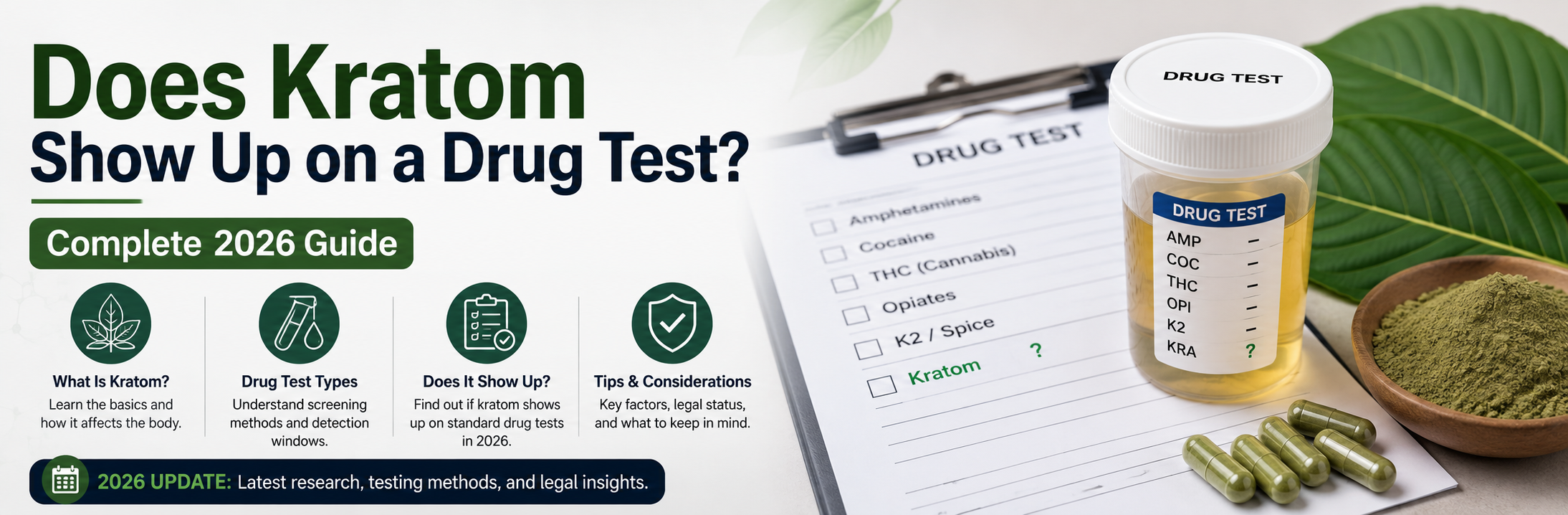
Does Kratom Show Up on a Drug Test? Complete 2026 Guide
If you use kratom and have a drug test coming up — for a job, a team, probation, or the military — the practical answer is that a standard kratom drug test isn’t part of most screening. Standard panels look for specific controlled substances, and kratom’s active alkaloids (mitragynine and 7-hydroxymitragynine) aren’t among them. This guide walks through each test type, summarizes what the (limited) research says about how long kratom is detectable, and covers false positives, DOT and workplace testing, and what influences detection.
No — kratom does not show up on a standard 5-panel drug test. The 5-panel test used by most employers screens for THC, cocaine, amphetamines, opiates, and PCP. Kratom’s alkaloids aren’t on that panel. Kratom can be detected only by a specialized kratom test that a testing program has to specifically order — and those are uncommon. Below: which tests can detect kratom, what the research says about detection windows, and the factors that affect results. None of this is medical or legal advice.
📋 Table of Contents
- Does Kratom Show Up on a Standard Drug Test?
- Does Kratom Show Up on a Military Drug Test?
- How Long Does Kratom Stay in Your System?
- Kratom Detection Windows by Test Type
- Can Kratom Cause a False Positive?
- A Bigger Real-World Risk: Product Quality
- What Factors Affect How Long Kratom Stays Detectable?
- Frequently Asked Questions
Does Kratom Show Up on a Standard Drug Test?
For the vast majority of standard drug tests — employment screening, sports, general medical — kratom is not detected. Here’s how the common panels break down:
- 5-panel test — not detected. The standard 5-panel screens for THC, amphetamines, cocaine, opiates, and PCP. Kratom’s alkaloids are not included in this panel.
- 10-panel test — usually not detected. The 10-panel adds substances like benzodiazepines, barbiturates, and methadone, but standard versions still don’t screen for kratom’s alkaloids.
- Kratom-specific tests — can detect it. Specialized tests exist and are used mainly in forensic, clinical, or treatment-monitoring settings. They use mass spectrometry (LC-MS/MS) to identify mitragynine and its metabolites, and a program has to specifically order and pay for them.
| Test Type | Detects Kratom? | Commonly Used For |
|---|---|---|
| Standard 5-panel | No | Most employment screening |
| 10-panel | Usually no | Expanded employment / clinical |
| Kratom-specific (LC-MS/MS) | Yes | Forensic, clinical, treatment monitoring |
Note: this means kratom’s alkaloids are not part of the standard 5-panel — not that any use is undetectable in every circumstance. If a program orders a kratom-specific test, it can be detected.
Does Kratom Show Up on a Military Drug Test?
As of 2026, kratom is prohibited across all U.S. military branches. The Department of Defense added kratom to its list of prohibited substances (a directive making use a violation effective December 31, 2025), and the individual branches have issued their own bans — the Navy and Marines in January 2026, the Coast Guard in May 2026, and the Army in June 2026, with the Air Force treating kratom as banned under its existing prohibition on naturally occurring intoxicating substances. Under the Uniform Code of Military Justice, using kratom can be treated as failure to obey a lawful general order.
Two things are worth separating clearly, because they are not the same:
- Kratom is prohibited under current U.S. military policy. If you are an active service member, using or possessing kratom is against military rules as of 2026 — regardless of whether it is legal in your state, and regardless of whether a test detects it. The disciplinary risk comes from the rule against use, not only from testing.
- It is not on the standard panel — but it can be tested for. Routine military urinalysis screens for the standard substances (THC, cocaine, amphetamines, opiates, PCP and similar) and does not include kratom’s alkaloids. However, specialized laboratory testing that detects mitragynine does exist, and now that kratom is prohibited, there is real potential for it to be tested for when a command has reason to. In short: routine tests generally won’t catch it, but detection is possible, and use itself carries consequences.
If you serve, the responsible course as of July 2026 is straightforward: do not use kratom, and direct any questions to your command or a military legal advisor. This situation is evolving, and newer guidance may supersede what’s described here.
How Long Does Kratom Stay in Your System?
Honest answer: the research is limited, and the numbers vary a lot between studies. Kratom’s pharmacokinetics have only been studied in humans a handful of times, usually with small groups, so any figure you see (including on this page) is a reported range, not a guarantee.
The first human pharmacokinetic study (2015, ten volunteers) reported a terminal half-life for mitragynine of roughly 24 hours — but with a very wide margin, meaning individual results ranged widely [1]. Other studies using kratom tea have reported much shorter half-lives, in the range of about 3 to 9 hours [2][3], while some estimates in frequent users run considerably longer at steady state. In one 2024 controlled study, trace mitragynine was still measurable in some subjects around ten days after a single serving, though at very low levels [4]. For a deeper look at clearance, see our guide on how long kratom stays in your system.
Kratom Detection Windows by Test Type
When a program does use a kratom-specific test, the detectable window depends on the sample type. The ranges below are drawn from forensic and clinical toxicology reports; they vary by individual and are not guarantees.
| Test Type | Detects Kratom? | Reported Window | Notes |
|---|---|---|---|
| Urine | Yes (specific test) | ~1 to 7 days; longer for heavy use | Most common method |
| Blood | Yes (specific test) | ~1 to 3 days | Invasive, less common |
| Saliva | Limited/emerging | ~up to ~48 hours | Not widely used |
| Hair follicle | Yes (specialized test) | Up to ~90 days | Exists but rarely used outside forensic/legal |
| Standard 5-panel | No | N/A | Does not test for kratom |
Does Kratom Show Up on a Urine Test?
Urine is the most common method for a kratom-specific test. Reported detection windows vary — commonly cited as somewhere in the range of about one to seven days after last use, with longer windows reported for frequent or heavy users [5]. These are reported ranges, not fixed guarantees, and individual results differ.
What users report (not measured data): In online communities, people using at-home kratom urine strips often describe testing positive well past the commonly cited windows — sometimes one to two weeks, and in heavy-use cases even longer, with the test line slowly fading over time. These are personal accounts, not controlled measurements, and they aren’t a substitute for the research. But they line up with what the studies suggest: detection is highly individual, and it can run long for frequent or heavy users. This is exactly why controlled studies matter — and why no one can promise you a specific number.
Does Kratom Show Up on a Blood Test?
Blood testing generally detects kratom only in a short window after use — reports put it at roughly one to three days. Blood draws are more invasive and less commonly used for kratom than urine.
Does Kratom Show Up on a Hair Follicle Test?
Specialized hair tests for kratom do exist — some labs (such as USDTL and ACS Laboratory) offer them, and in theory kratom’s alkaloids can be detected in hair for up to about 90 days. But these are not part of standard hair panels and are rarely used outside forensic, legal, or strict treatment/probation contexts. For a routine employment screen, a kratom hair test is very unlikely.
Does Kratom Show Up on a Saliva Test?
Saliva (oral fluid) testing for kratom is emerging but not a common or standardized screening method as of 2026. Where used, the window is short — reported at roughly up to two days.
Can Kratom Cause a False Positive?
There is documented evidence that kratom can trigger a false positive on one specific screening — the methadone metabolite (EDDP) immunoassay. A peer-reviewed case study found that a kratom metabolite cross-reacted with that test, producing a positive methadone screen that a follow-up mass-spectrometry test then cleared [6]. This is a narrow, documented interference, not a broad “kratom shows up as opioids” effect. If you ever receive an unexpected positive, a confirmatory GC-MS or LC-MS test can distinguish kratom’s alkaloids from actual opioids.
A Bigger Real-World Risk: Product Quality
Here’s some context many headlines leave out. When a story says someone “overdosed on kratom,” the toxicology usually shows other substances — heroin, fentanyl, or other drugs — were involved, and the headline rarely mentions them. Deaths involving kratom alone appear to be rare: one CDC review of kratom-involved overdose deaths found that a small number involved kratom by itself [8]. The point isn’t that kratom carries zero risk — it’s that the sensational version isn’t the full picture, and the genuine testing risk usually isn’t pure kratom triggering a positive; it’s adulterated product. Regulators and independent labs have found some kratom sold on the market cut with pharmaceutical opioids or other contaminants [7] — and a contaminated product can produce a true positive for whatever it was cut with. That’s exactly why third-party testing matters. Every batch we carry is tested by independent labs (most often Murray Brown) for microbials, heavy metals, and alkaloid content, and you can scan the package to pull up the report. See our lab results page.
What Factors Affect How Long Kratom Stays Detectable?
Several factors influence how long kratom’s alkaloids remain detectable. These affect detectability — they are not a method for altering a test result.
Age and Metabolism
Older individuals generally process substances more slowly as kidney and liver function change with age, which can lengthen how long metabolites remain detectable.
Body Composition
Kratom’s alkaloids have fat-soluble properties, so body composition can influence how they’re stored and cleared. This is one reason detection windows differ from person to person.
Genetics and Enzyme Activity
Individual differences in liver enzymes (such as those in the CYP450 family) affect how quickly kratom is metabolized, which varies naturally from person to person.
Diet and Hydration
General metabolism and hydration status can influence clearance rates, as they do for many substances processed by the body.
Frequency and Serving Size
Frequent or heavy users may have longer detection windows than occasional users, since alkaloids can accumulate with repeated use. For general serving information, see our kratom dosage guide.
Frequently Asked Questions — Does Kratom Show Up on a Drug Test?
Related: is kratom legal in my state · kratom dosage guide · what is kratom · explore lab-tested kratom powder and capsules.
Sources
- Trakulsrichai S, et al. Pharmacokinetics of mitragynine in man. Drug Design, Development and Therapy, 2015. (First human PK study; terminal half-life ~23.24 ± 16.07 hours, n=9.)
- Human kratom-tea pharmacokinetic study reporting elimination half-life ~8.7 hours (ACS Pharmacology & Translational Science).
- StatPearls (NIH/NCBI Bookshelf), Kratom — cites an estimated mitragynine half-life of ~3 hours; notes variability.
- Human mitragynine/7-hydroxymitragynine PK after single and multiple oral dried-leaf doses; trace measurable ~10 days post single dose (Molecules, 2024).
- Forensic/clinical toxicology sources on urine detection windows (commonly cited ~1–7 days; longer in heavy users).
- Pierre C, Gineste C, Bazydlo L. A Kratom Metabolite Causes False Positive Urine Drug Screening Results for Methadone. American Journal of Clinical Pathology, 2020.
- US FDA and independent laboratory analyses reporting adulteration of some commercial kratom products.
- CDC review of kratom-involved overdose deaths (2019 study of unintentional overdose deaths, July 2016–Dec 2017): of 91 kratom-involved deaths analyzed, a small number (seven) involved kratom with no other substances detected.
- Military kratom prohibition (as of July 2026): DoD Operation Supplement Safety prohibited-substances list; branch actions — Navy/Marines ALNAV (Jan 2026), Coast Guard general order (May 2026), Army memo (June 2026), Air Force prohibition on naturally occurring intoxicating substances. Reported by Stars and Stripes, Military Times, Task & Purpose.
- 49 CFR Part 40 (eCFR) — DOT-tested drugs: marijuana, cocaine, amphetamines, PCP, opioids.